2026 State Animal Protection Legislation
The 2026 New Mexico legislative session has started and will continue through February 19. Here’s where we will be posting updates on the status of our priority legislation, as well as other animal-related legislation. Sign up for our emails for the very latest updates.
Animal Protection Voters Priority Legislation

SB 38: Fees on Registered Pet Food
Sponsors: Sen. Peter Wirth, Rep. Cristina Parajón, Rep. Joanne J. Ferrary, Sen. Elizabeth Stefanics, Sen. Heather Berghmans
Senate Bill 38 will save New Mexico’s Affordable Spay/Neuter Law by removing the repeal date of July 1, 2026, reflected in the current law. It is imperative that this Law remains, as access to affordable spay/neuter (for dogs and cats) is a vital community service all New Mexicans want and deserve, especially in rural, Tribal, and low-income areas.
The Law provides funding to curb dog and cat overpopulation in New Mexico through grants for affordable spay/neuter surgeries. As shelter overcrowding rises, the tax dollars that sustain municipal shelters will be spent not only on daily operations but on addressing the high costs associated with euthanizing animals for lack of space. If the repeal date is not removed from the statute by the Legislature before February 19th, and then approved by the Governor’s signature, the Affordable Spay/Neuter Law will go away. SB 38 removes the repeal date.
Status Updates:
- 1/22/26: Passed out of the Senate Committees Committee (11-0 vote)
- 1/27/26: Passed out of the Senate Conservation Committee (7-2 vote)
- 1/29/26: Passed out of Senate Tax, Business & Transportation (10-0)
- 2/5/26: Passed out of the Senate (23-15)
- 2/12/26: Passed out of the House Consumer & Public Affairs Committee (4-1)
- 2/16/26: Passed out of the House Judiciary Committee (10-1)
- 2/18/26: Passed out of the House (53-11)
- 3/5/26: Signed into law by the Governor!

HB 243: Equine Shelter and Trust Fund
Sponsors: Rep. Joseph L. Sanchez, Rep. Tara L. Lujan, Rep. G. Andrés Romero, Rep. Cynthia Borrego
New Mexico faces unique and growing challenges concerning equines (horses, donkeys, and mules), including keeping homeless and abused horses from entering the slaughter pipeline through safe placement with registered equine shelters and rescues. Several nonprofit equine shelters currently assist the New Mexico Livestock Board (NMLB) and other law enforcement agencies by taking in and caring for impounded or seized equines. The NMLB disburses money from the Equine Shelter Rescue Fund (ESRF) to the equine shelters to help defray some of the costs associated with caring for those animals.
Status Updates:
- 2/3/26: Stalled in House Agriculture, Acequias And Water Resources Committee (Do Pass Motion failed on a tie vote 4-4)
- Died awaiting action by the House Agriculture, Acequias And Water Resources Committee
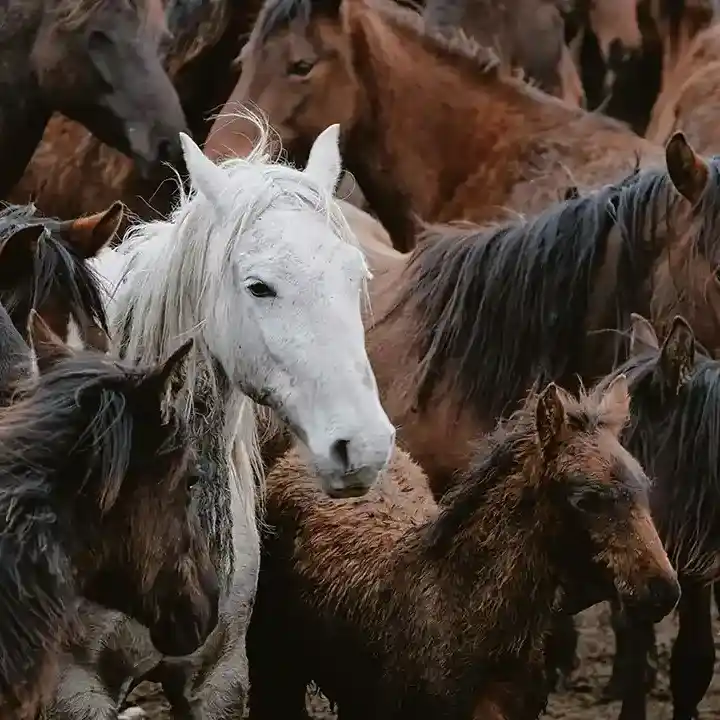
HB 300: Care & Management of Horses
- 2/5/26: Passed out of the House Agriculture, Acequias and Water Resources Committee (6-0)
- Did not advance to a hearing in the House Appropriations & Finance Committee, and the appropriation was not included in the state budget.

HB 315: Promoting the Humane Management of Free-Roaming Horses
Sponsor: Rep. Matthew McQueen
New Mexico is home to many herds of free-roaming horses that are not under federal management, and while these horses are often cherished by communities, in some areas they lack adequate protection and face degraded habitat and increasing conflicts with wildlife and other land uses. This legislation would update the current law by allowing local governments to take the lead on free-roaming horse protection and management by working with qualified experts registered with the New Mexico Livestock Board who are skilled in determining land carrying capacity, using the best available science, and employing humane methods to stabilize herd size and relocate horses when necessary. The bill would also include guardrails to prevent the slaughter of New Mexico’s wild and free-roaming horses and to preserve our landscapes. Although it passed the House and the Senate almost unanimously in 2025, it was ultimately pocket vetoed by the governor.
Status Updates:
- Awaiting a hearing in the House Agriculture, Acequias And Water Resources Committee
- Died awaiting action by the House Agriculture, Acequias And Water Resources Committee

Funding CARE to Help People with Companion Animals Escape Domestic Violence
Since 2000, the Companion Animal Rescue Effort (CARE), operated by Animal Protection New Mexico, has helped domestic violence survivors stay safe with their pets by operating a helpline that connects them to secure temporary housing and care for companion animals and by supporting shelters across New Mexico in becoming animal-inclusive through training, supplies, site visits, and long-term planning. The State of New Mexico has long recognized the value of these services and currently contracts with APNM to provide CARE, but without adequate funding from the Legislature in the 2026 session, these critical services for survivors and their pets are at risk.
Status Updates:
Other Bills APV Supports
HB 51: Spay & Neuter Fee Delayed Repeal
Sponsors: Rep. Jenifer Jones, Rep. Kathleen Cates, Rep. D. Wonda Johnson,
House Bill 51, similar to Senate Bill 38, aims to save New Mexico’s Affordable Spay/Neuter Law by removing the repeal date of July 1, 2026 (reflected in the current law). The Affordable Spay/Neuter Law generates funding through fees paid by pet food manufacturers to curb dog and cat overpopulation in New Mexico through grants to affordable spay/neuter providers. If the repeal date is not removed from the Affordable Spay/Neuter Law by the Legislature before February 19th, and then approved by the Governor’s signature, the Law will go away. HB 51 removes the repeal date.
Status Updates:
- 1/22/26: Awaiting action by the House Rules & Order of Business Committee
- Died awaiting action by the House Rules & Order of Business Committee
HB 130: CYFD Domestic Violence Programs Funding
Sponsor: Rep. Pamelya Herndon
House Bill 130 makes a request for $5 million dollars from the general fund to the Department of Children, Youth and Families (DYFD) for community-based domestic violence programs. If appropriated to CYFD, funds from the appropriation could be used for a variety of services and support programs to assist people, including people with companion animals, experiencing domestic violence.
Status Updates:
- 1/28/26: Passed out of the Health & Human Services Committee (10-0 vote)
- Awaiting a hearing in the House Appropriations & Finance Committee
HB 177: Veteran Service Animal Services & Shelter
Sponsors: Rep. Alan T. Martinez, Rep. Mark Duncan, and Rep. Rebecca Dow
Barriers to veterans’ well-being include safe, humane, and consistent care for their service and companion animals so that they themselves can access medical care, stable housing, and support services. House Bill 177, also known as the “No Companion Left Behind Act,” is aimed at lowering those barriers through a $150,000 appropriation to the Veterans’ Services Department to provide veterans’ animals with pet food, boarding, veterinary care, and on-site kennels at facilities primarily housing veterans.
Status Updates:
- 1/29/26: Passed out of the House Labor, Veterans and Military Affairs Committee (8-0)
- Awaiting a hearing in House Appropriations & Finance
SB 63: Animal Welfare Fund Spay & Neuter Sub-account
Sponsors: Sen. Craig W. Brandt and Sen. Steve D. Lanier
Senate Bill 63 would create a sub-account within the existing Animal Welfare Program Fund (established with the passage of House Bill 113 in 2025) for counties to contract with dog and cat spay/neuter providers. Unlike the spay/neuter sub-account that currently exists within the Animal Care and Facility Fund, which receives funding through registration fees paid on dog and cat food by large pet food manufacturers, the sub-account created by SB 63 would be seeded with an initial $2 million dollar appropriation for the first year, and could receive additional legislative appropriations thereafter. Thus, the funding mechanisms for the two different spay/neuter sub-accounts would be complimentary, not duplicative, and both are desperately needed to provide spay/neuter services in rural, Tribal and underserved communities.
Status Updates:
- 1/23/26: Determined not germane (without a Governor’s executive message) by the Senate Committees’ Committee
SB 74: Cockfighting Penalties
Sponsor: Sen. Craig W. Brandt
While organizing or causing a cockfight has been illegal in New Mexico since 2007, being a spectator at a cockfight is not currently against the law. Senate Bill 74 would make spectating—that is, being present at or attending—a cockfight illegal. Further SB 74 would strengthen the penalties against cockfighting. Unlike dog fighting, which is a felony on the first conviction, the penalties for cockfighting are petty misdemeanor for the first conviction and misdemeanor for the second conviction. Only after having two prior cockfighting convictions can an offender be charged with a felony for cockfighting. Under SB 74, conviction for causing or spectating at a cockfight would be punishable as a fourth-degree felony on first offense, which is punishable by up to 18 months in jail, a $5,000 fine, or both. This legislation will need a message from the Governor to be considered germane.
Status Updates:
- 1/22/26: Awaiting action by the Senate Committees’ Committee
- Died awaiting action by the Senate Committees’ Committee
SB 80: Animals in Protective Orders
Sponsor: Sen. Antoinette Sedillo Lopez
Senate Bill 80 will update New Mexico’s law against family violence in two important ways. Unlike 42 other US States, does not explicitly state animals can be included in protective orders. Additionally, the law should be updated to recognize animal abuse with the intent to harm or intimidate someone is a form of domestic violence. SB 80 corrects both of these omissions to better protect people and animals subjected to domestic violence. This legislation will need a message from the Governor to be considered germane.
Status Updates:
- 1/22/26: Awaiting action by the Senate Committees Committee
- Died awaiting action by the Senate Committees’ Committee
SB 102: “Search & Rescue Dog” Definition
Sponsor: Sen. Craig W. Brandt
Senate Bill 102 will add search-and-rescue dogs to the list of animals covered by the statute that defines crimes against animals used by first responders and law enforcement, such as police dogs, police horses, and fire dogs. Further, SB 102 enhances penalties for causing minor physical injury, or causing serious physical injury or death, to first responders and law enforcement animals. Currently, the penalty for physical injury to such an animal is a petty misdemeanor. SB 102 would change the penalty to a third-degree felony with potential for 5 years imprisonment, a $5,000 fine, or both. Likewise, the current penalty for causing serious injury or death to such an animal is a fourth-degree felony. SB 102 would increase the penalty for causing serious injury or death to a second-degree felony punishable by up to 15 years imprisonment, a $10,000 fine or both. This legislation will need a message from the Governor to be considered germane.
Status Updates:
- 1/22/26: Awaiting action by the Senate Committees Committee
- Died awaiting action by the Senate Committees’ Committee
SB 104: Removal of Wildlife Commission Members
Sponsor: Sen. Peter Wirth, Sen. Pete Campos, Rep. Nathan P. Small, Rep. Matthew McQueen, Sen. Crystal Brantley
Senate Bill 104 provides the final puzzle piece to the big overhaul of Wildlife Commission and Department of Wildlife achieved by last year’s Senate Bill 5. The Governor thankfully signed SB 5 into the law, but struck provisions in the bill that outlined the process for removing Wildlife Commissioners for malfeasance, incompetence, or neglect of duty. SB 104 adds a clear, fair, and efficient removal process—ensuring that Wildlife Commissioners can serve without undue political influence, and can be swiftly removed for disqualifying behavior. This legislation received a message from the Governor, making it germane for the short session.
Status Updates:
- 1/29/26: Passed out of the Senate Committees Committee (8-0)
- 1/30/26: Passed out of the Senate Rules Committee (10-0)
- 2/9/26: Passed out of the Senate Judiciary Committee (8-0)
- 2/11/26: Passed out of the Senate (36-0)
- 2/12/26: Passed out of the House Energy, Environment & Natural Resources Committee (10-0)
- 2/14/26: Passed out of the House (69-0)
- 2/19/26: Passed into Law!
Anti-Animal Legislation
SB 113: AGRICULTURAL BIOMASS TAX CREDIT AMOUNTS
Sponsor: Sen. Antonio Maestas
Senate Bill 113 doubles the tax credit for transporting manure from dairy and feedlot operations (agricultural biomass) to facilities for energy production. This increased tax credit, which encourages the expansion of large-scale dairy farms and CAFOs (confined animal feeding operations), falsely frames methane and carbon dioxide produced by factory farms as a sustainable “win-win” solution for the environment and energy production. In reality, methane and carbon dioxide are potent greenhouse gases and significant drivers of climate change.
New Mexico already has the largest average dairy herd size in the country, and dairies are the site of some of the worst large-scale animal cruelty found in the state. In 2025, the New Mexico Livestock Board undertook a felony animal cruelty investigation of a dairy in Roswell with approximately 6,000 dairy cows and calves, after footage showed cows being brutally beaten and pregnant cows having calves prematurely and violently extracted, resulting in injury and death. APV opposes SB 113 because it would give CAFOs and mega-dairies a green light to get even bigger and create even bigger problems.
Status Updates:
- 1/29/26: Held in Senate Tax, Business & Transportation Committee; pending possible inclusion in the omnibus tax package
- Died awaiting action by the Senate Tax, Business & Transportation Committee
Looking for legislation from years past? View our bill archive.